WriteHuman, a better alternative to NoteGPT
WriteHuman vs NoteGPT: real-world performance
HumanizerBench is a public benchmark that re-tests every major AI humanizer each month. Each tool is paid for and run by hand on the same prompts, then scored against 5 major AI detectors on how human the output reads, how well it keeps the original meaning, and how cleanly it's written. Every prompt, output, and detector score is published.
Tested June 202630 samples390 tests5 AI detectors
| Metric | WriteHuman | NoteGPT |
|---|---|---|
Overall score Composite out of 100. Weights AI-detector results 42%, meaning 32%, readability 16%, and consistency 10%, then subtracts quality penalties. | 83.59 | 45.34 |
AI-detector pass rate Share of checks where the output read as human-written, across all 5 AI detectors. | 84.5% | 0.0% |
Meaning preserved How closely the rewritten text keeps the original meaning. | 71.8% | 66.7% |
Quality penalties Points deducted from the overall score for quality issues like length inflation or meaning drift. Lower is worse. | No penalties | -2 pts |
AI-detector pass rate, by detector Share of checks on each detector where WriteHuman's output read as human-written. Showing detectors where WriteHuman scores higher. | ||
GPTZero | 78.2% | 0.0% |
Winston AI | 84.5% | 0.2% |
ZeroGPT | 74.3% | 38.1% |
Copyleaks | 68.7% | 3.5% |
Originality.ai | 46.3% | 0.0% |
Score by content type Benchmark score by writing category. Showing categories where WriteHuman scores higher. | ||
Blog posts | 87.6% | 0.0% |
News articles | 93.0% | 0.1% |
Marketing copy | 75.7% | 0.0% |
Discussion posts | 97.4% | 0.0% |
Scoring methodology ↗See the full head-to-head on HumanizerBench ↗
See the actual outputs
The scores above come from real tests, not marketing claims. Here are unedited results from the June 2026 run: the same AI-generated text, humanized by each tool, shown side by side.
10 Tips for Improving Home Wi-Fi Coverage Tired of buffering videos and dead zones in your house? You're not alone. Bad Wi-Fi is one of those modern-day frustrations that can turn a chill Netflix night into a rage-inducing nightmare. The good news? You don't need to be a tech wizard to fix it. Here are…
10 Tips for Improving Home Wi-Fi Coverage
It’s frustrating streaming videos and having dead zones in your home. Slow Wi-Fi can turn an evening watching Netflix into an evening of rage. You don’t have to be tech-savvy to solve this problem. Here are 10 ways to improve home Wi-Fi.
- Place Router in Home Center
Stop hiding the router in a closet. Wi-Fi signals spread in every direction. Placing the router in the center of the home gives the best spread.
- Elevate Router
Signals will spread further if the router is elevated. Place the router on a shelf or mount the router to the wall.
- Distancing Electronics
Microwaves and even baby monitors can disrupt Wi-Fi signals. Give your router more space and keep it distanced from other electronics.
- Updating Router Firmware
Don’t forget to log in to the router every few months to check for an update. An update can improve performance and security.
- Change Channel
If your neighbor’s Wi-Fi is disrupted, changing your channel will help. Most routers will allow you to change this in the admin settings. Use channels 1, 6, and 11 for a 2.4GHz.
- Use The 5 GHz Band.
If you use a dual-band router, you can connect to the 5 GHz band for faster speeds. Just remember that with this band, the signal won't reach as far.
- Add A Wi-Fi Extender or Mesh System.
If your house is big or you have a complicated layout, you might want to use a mesh Wi-Fi system (so something like Eero Wi-Fi or Google Nest Wi-Fi). They are great for eliminating dead zones in your house.
- Reboot Regularly.
Sometimes, as weird as it is, your router needs some sleep. You should unplug it for 30 seconds and then plug it back in. You'd be shocked at how many weird problems this fixes.
- Secure Your Network.
If your Wi-Fi has no password then your neighbors probably have no issues using your Wi-Fi. Make a strong password with either WPA3 or WPA2 encryption.
- Upgrade Your Router.
If your current router is 5 or more years old, you seriously might have to consider getting a new one. The newer routers with Wi-Fi 6 ( or 6E) are way faster and better able to handle more connections.
Using a couple of these tips will get rid of those buffering circles and you can use your Wi-Fi to its full potential.
How to Publish a Self-Illustrated Picture Book: A Step-by-Step Guide Creating and publishing your own illustrated picture book is a rewarding journey that combines storytelling with visual art. Here's how to bring your project to life. ## 1. Refine Your Story First Before picking up a pencil, polish your manuscript. Picture books typically run 200–800…
Another Way to Publish a Self-Illustrated Picture Book: A Step-by-Step Method
Self-illustrating a picture book is a great opportunity to combine your love of art and writing and publish a book that you can be proud of. This guide goes through some of the steps that you can take to make your book a reality.
- Finalize your story
It is always best to have a final draft of your story before starting to draw. Picture books generally have an average of 200-800 words and consist of 32 pages. When drafting your story, make sure to read it out loud and gather feedback from children to get a better idea of your audience. Make sure to leave gaps for illustrations to help with your story.
- Create a Dummy Book
To help organize your story with text and illustrations, create a dummy book. This book can have your story drawn in thumbnails to show how you want text to be placed in your picture book. This helps to figure out how text placement helps with the flow, rhythm, and suspense of your picture book.
- Develop your Illustrations
Use the same medium that you used for your dummy book to draft your illustrations for the book. Make sure that all of the illustrations and spreads that you draft stay consistent. Illustrations that are draft should stay at 300 DPI with an almost ½ inch bleed around the edges.
- Choose your Publishing Path
Traditional Publishing: If you decide you want to go the traditional publishing route for your book, you will have to do some research on the publishers and agents that accept picture book submissions. As the author and illustrator, you have an advantage since publishing houses do not have to create a complete package.
Self-Publishing: Self-publishing through means like IngramSpark, Amazon KDP, or Blurb allows you to have more ownership and more control of your money, but forces you to complete all production and marketing duties yourself.
Step 5. Make Production Files
Publishing through a traditional publisher requires understanding more of the industry and the technical side, while self-publishing helps you self-manage and learn, but still requires some technical knowledge. You will need help setting up your production files. Make sure you include bleed (0.125) and are using CMYK. Editing and proofreading can’t be skipped as it can be costly to have printing errors.
Step 6. Prepare for Production
You will want to have an active author website and social media by the time your book is up for sale. Plan in person readings and send out copies to the right reviewers. You also need to consider how the season can affect people's choice.
Step 7. Develop and Maintain a Marketing Plan
Publishing a picture book requires a lot of work and the product sometimes does not live up to the artist's expectations, but it helps develop vital skills, and seeing it in your target market's hands makes it worth it.
Each tool was run by hand and screen-recorded during the June 2026 run. The outputs are then scored programmatically against five major AI detectors, and every input, output, and detector score is published on GitHub. Watch the unedited humanization sessions (video opens in a new tab):
WriteHuman vs NoteGPT in 60 seconds
The headline differences. Detailed analysis below.
- Starting price
- $18/mo Basic
- Free tier
- Free to use, no signup, no card
- Standout
- Scored 83.59 in the June 2026 HumanizerBench cycle with an 84.5% AI-detector pass rate and zero quality penalties, tested on the entry Basic plan
- Starting price
- From $9.99/mo Pro
- Free tier
- Free: 15 quotas/mo, no card
- Watch for
- A capable all-in-one tool for generating notes, summaries, and transcripts from long videos, PDFs, and audio
Bottom line: Reach for NoteGPT to generate and summarize content from long sources. Choose WriteHuman when an existing draft has to read as human-written to detectors.
Different tools
NoteGPT generates content; WriteHuman rewrites it to read as human
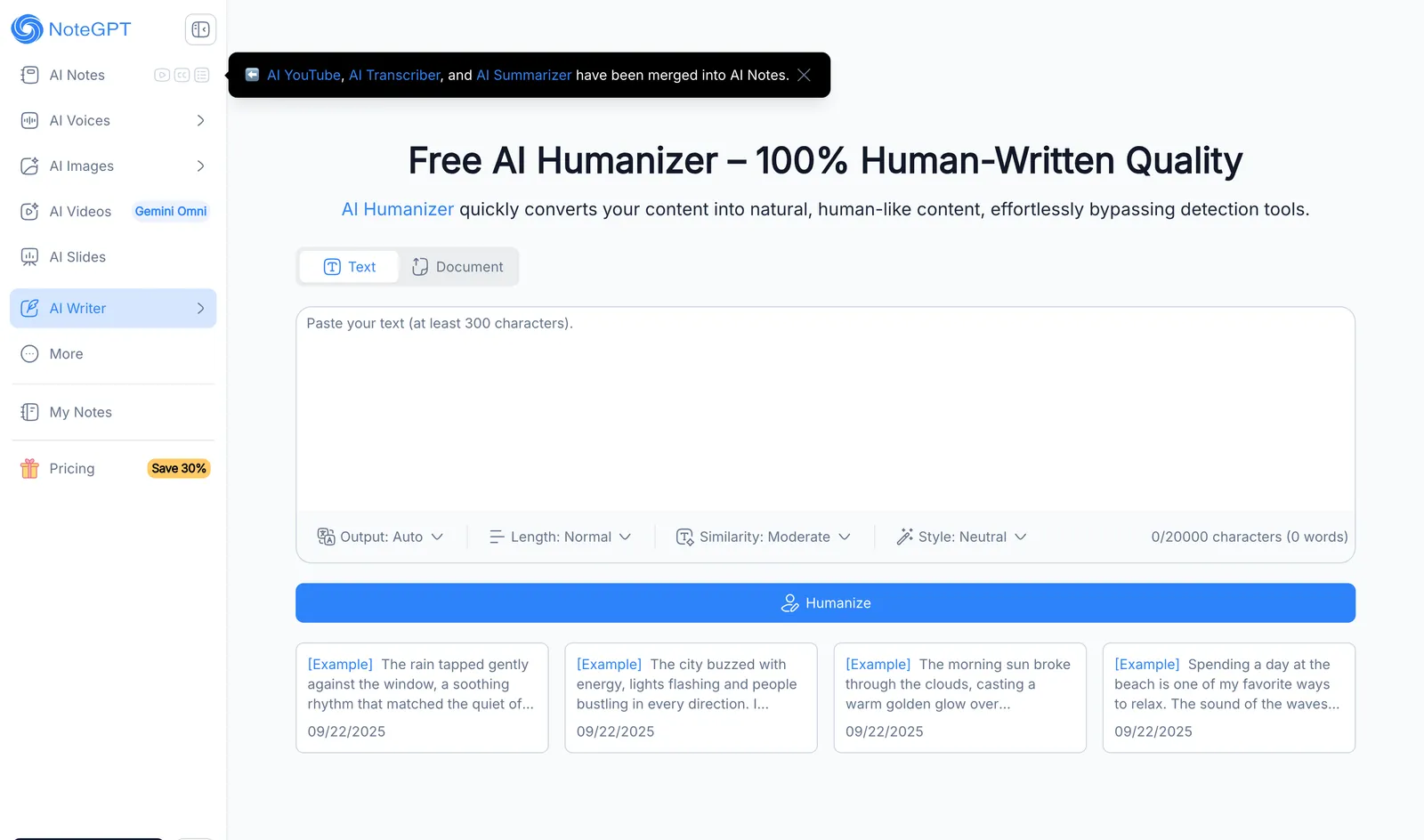
NoteGPT is built to create. Point it at a long video, a dense PDF, or an audio file and it returns notes, a summary, or a transcript, then layers on AI chat, image generation, and voice tools. It is a productivity suite, and a capable one. People sometimes arrive at its bolt-on humanizer expecting it to take a finished AI draft and make that draft read as human-written, which is a different job entirely.
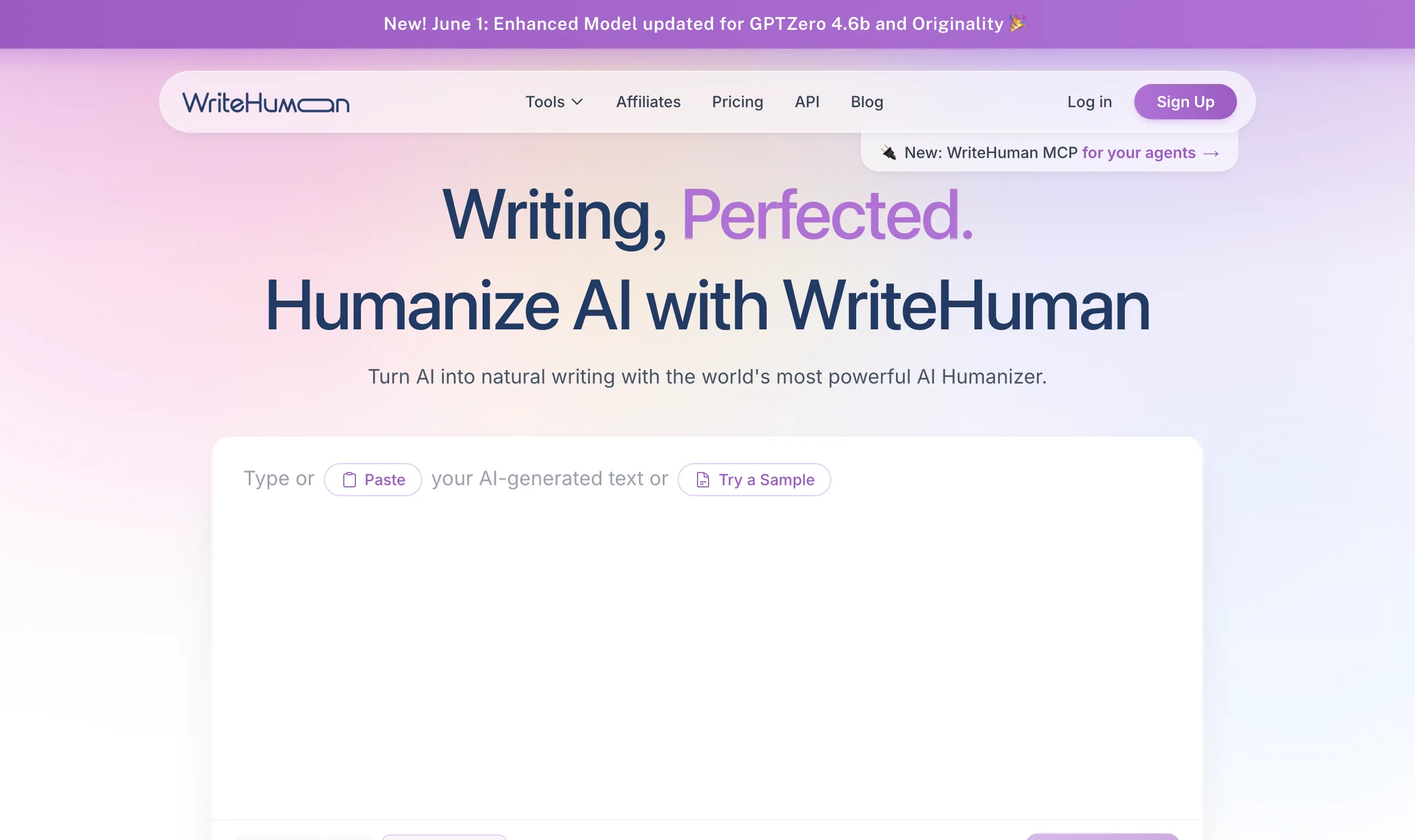
WriteHuman does only that one job. You paste an existing draft and it rewrites the structure, sentence rhythm, burstiness, transitions, and idiom, while keeping your vocabulary, citations, and quotes intact and the word count close to the original. If your goal is to generate a summary, NoteGPT is the right shelf. If your goal is writing that reads as human-written, that is what WriteHuman is engineered for.
Humanizing is one feature inside NoteGPT's broad productivity suite of notes, summaries, and transcripts.
WriteHuman does one job: take an existing AI draft and make it read as human-written.
Detector performance
On the one job they overlap, the gap is decisive
Both tools ship a humanizer, so HumanizerBench tested them head to head in the June 2026 cycle on 30 samples each. NoteGPT's humanized output scored a 0% AI-detector pass rate. Across the individual detectors it read as AI at GPTZero (0%), Winston AI (about 0%), Copyleaks (about 4%), and Originality.ai (0%), with ZeroGPT the only outlier near 38%.
WriteHuman posted an 84.5% pass rate in the same cycle and led on all five detectors and all four content categories. That is the difference between a tool that happens to include a humanizer and a tool whose entire reason to exist is producing writing that reads as human-written.
NoteGPT's humanized output scored a 0% AI-detector pass rate in the June 2026 cycle.
WriteHuman's AI-detector pass rate in the same cycle, leading all five detectors.
Overall quality
Composite score and clean output, not just one metric
Detector scores are only half the story. A humanizer also has to preserve what your draft was trying to say and avoid mangling it into broken sentences. On meaning preservation, WriteHuman scored 71.8% against NoteGPT's 66.7%, and on quality penalties WriteHuman took zero while NoteGPT took two. So WriteHuman both reads as human-written more reliably and holds the meaning better.
Those pieces add up to the composite. WriteHuman finished at 83.59 out of 100, all on its entry-level Basic plan. NoteGPT finished at 45.34, a 38-point gap. When the same benchmark scores generation quality and humanization quality side by side, the specialist wins the humanization race by a wide margin.
NoteGPT's composite in the June 2026 cycle, a 38-point gap behind WriteHuman.
WriteHuman's composite in the same cycle, on its entry-level Basic plan.
Specialist vs suite
A broad suite, asked to do a specialist's job
NoteGPT's strength is breadth. It packs notes, summaries, transcription, AI chat, and image generation into one place, and for pulling structure out of long source material that breadth is genuinely useful. Humanization is one feature among many, not the product, and the June 2026 benchmark shows the cost of that split focus: a 0% AI-detector pass rate, a -2 quality penalty, and a 45.34 composite that lands a full 38 points behind WriteHuman.
WriteHuman is the inverse. It does one job and tunes everything toward it, then ships a built-in AI detector in the same view so you can check the result before you publish. When a draft has to read as human-written to detectors like GPTZero, Originality.ai, Copyleaks, ZeroGPT, and Winston AI, a focused tool is the safer bet, and the benchmark is where that focus shows up.
NoteGPT's meaning-preservation score in the June 2026 cycle.
WriteHuman's meaning preservation in the same cycle, with zero quality penalties.
Pricing: WriteHuman vs NoteGPT
Side-by-side plans. WriteHuman's free tier is on the homepage. No signup needed.
Free
$0
Try the humanizer with daily limits, no signup
- No credit card
- Daily request cap
- Built-in AI detector access
Basic
$18/mo
80 humanizations / month, up to 600 words each
- 2 output variations
- 160 AI detector checks / mo
- Cancel anytime
Pro
$27/mo
200 humanizations / month, up to 1,200 words each
- 3 output variations
- 400 AI detector checks / mo
- Priority support
Ultra
$48/mo
Unlimited humanizations, up to 3,000 words each
- 5 output variations
- Unlimited AI detector checks
- Priority support
Free
$0
15 quotas/mo across the suite, no card
Pro
$9.99/mo
1,000 basic quotas + 100 premium credits/mo
- $9/mo if billed yearly
- Credits cover the full NoteGPT suite, not a dedicated humanizer
Unlimited
$29/mo
Unlimited basic quotas + 2,800 credits/mo
- $19.92/mo if billed yearly
Max
$99/mo
Unlimited basic quotas + 10,000 credits/mo
- $69/mo if billed yearly
Pricing verified as of . For the latest NoteGPT pricing, see notegpt.io.
Feature Comparison
See how WriteHuman stacks up against NoteGPT, feature by feature.
What real NoteGPT users are saying
Quotes pulled from public reviews on Reddit, Trustpilot, G2, and Product Hunt.
“Don't even look at this tool if you are thinking to humanize the text.”
“Calling this 'free' is misleading. After signing up, you're immediately asked to pay $9.”
“I paid for their "Unlimited" plan and almost immediately got hit with an "Insufficient Basic Quota" error.”
Why writers pick WriteHuman
The everyday reasons writers switch to WriteHuman from NoteGPT.
Pick WriteHuman if…
- You already have an AI draft and need it to read as human-written to the major detectors.
- You are publishing professional, marketing, or client-facing content where the AI-detector score matters.
- You want structural rewriting that keeps your vocabulary, citations, and quotes intact.
- You want a built-in detector in the same view so you can verify before you publish.
- You want multiple output variations per request to pick the version that best preserves your voice.
Pick NoteGPT if…
- You want to generate notes or summaries from long videos, PDFs, or audio.
- You need an all-in-one suite that also does transcription, AI chat, and image generation.
- You are creating content from source material rather than rewriting an existing draft.
Why users switch from NoteGPT
Real pain points NoteGPT users run into, and how WriteHuman solves each one.
Its humanizer scored a 0% AI-detector pass rate in the June 2026 HumanizerBench cycle, reading as AI to GPTZero, Winston AI, Copyleaks, and Originality.ai.
WriteHuman posted an 84.5% AI-detector pass rate and led all five detectors in the same June 2026 cycle.
Composite of 45.34 versus 83.59, a 38-point gap, because humanization is a side feature rather than the core product.
WriteHuman scored a composite of 83.59, tested on its entry-level Basic plan.
Took two quality penalties in the benchmark, where a specialist humanizer took none.
WriteHuman took zero quality penalties in the benchmark, so cleaner output came with the higher pass rate.
Meaning preservation of 66.7% trailed WriteHuman's 71.8%, so even the rewrite fidelity lagged.
WriteHuman preserved meaning at 71.8%, keeping your vocabulary, citations, and quotes intact while it rewrites the structure.
Humanization is one feature inside a broad suite, so it does not get the focused tuning a specialist tool applies to the same job.
WriteHuman does one job and does it deeply, with a built-in detector in the same view so you verify before you publish.
Frequently asked: WriteHuman vs NoteGPT
Is NoteGPT a humanizer?
What is the best NoteGPT alternative for humanizing AI text?
Why does NoteGPT's humanized output still read as AI to detectors?
Should I use NoteGPT or WriteHuman?
Does WriteHuman have a free tier like NoteGPT?
Ready to make the switch?
Join 10,000,000+ writers who trust WriteHuman to transform their AI content into polished, natural-sounding writing.
No credit card required